Start with one consistent set of inputs
Record each ingredient's pack quantity, pack price, recipe quantity and measurement unit. Add a price-check date and record the batch yield separately: eight portions means eight portions of a specified size.
Convert pack and recipe quantities to the same unit. A 1 kg pack becomes 1,000 g when the recipe uses grams. Keep liquid measurements consistent too. Do not treat 1 mL as 1 g unless that conversion is appropriate for the ingredient.
A worked example: one batch, eight portions
Imagine an eight-portion pasta recipe. In this simplified first calculation, every listed ingredient quantity is fully usable and the pack prices are entered consistently.
| Ingredient | Pack quantity | Pack price | Recipe quantity | Recipe cost |
|---|---|---|---|---|
| Pasta | 1,000 g | $3.00 | 600 g | $1.80 |
| Tomatoes | 2,400 g | $4.80 | 900 g | $1.80 |
| Cheese | 1,000 g | $8.00 | 240 g | $1.92 |
| Oil | 1,000 mL | $6.00 | 80 mL | $0.48 |
| Herbs | 100 g | $2.00 | 20 g | $0.40 |
| Vegetables | 1,000 g | $5.00 | 600 g | $3.00 |
| Total ingredient cost | $9.40 | |||
The cheese calculation is $8.00 ÷ 1,000 × 240 = $1.92. Adding all six ingredients gives $9.40 per batch. Dividing $9.40 by eight gives $1.175, displayed as $1.18 per serving.
Put the calculation in a spreadsheet
In an illustrative sheet, place pack quantity in column B, pack price in C and recipe quantity in D. The ingredient cost in E2 is =C2/B2*D2. Copy the formula down for the remaining ingredients. If the six ingredient costs occupy E2:E7 and the portion count is in H2, use =SUM(E2:E7)/H2 for cost per serving.
These cell references describe the example, not a required SheetChief product layout. Flag missing prices, zero pack quantities and zero portions before relying on the result. Keep calculation precision and round the displayed amount at the end; repeatedly rounding intermediate costs can change the total.
Adjust for usable yield when it matters
If the recipe requires 600 g of prepared vegetables but only 80% of the purchased quantity is usable, you need 600 ÷ 0.80 = 750 g of purchased vegetables. At $5.00 per 1,000 g, their cost becomes $3.75 rather than $3.00. In this separate scenario, the batch costs $10.15 and each of eight servings costs about $1.27.
Use a measured preparation yield when you have one. Avoid adding the same loss twice through both a yield adjustment and a second waste allowance.
Check portions and price changes separately
Count portions using a defined scoop, weight or serving size. An unrealistic portion count creates an unrealistic plate cost.
Return to the original $9.40 batch and change only the cheese pack price from $8.00 to $10.00. The cheese used costs $2.40, adding $0.48 to the batch. The new total is $9.88, or about $1.24 per serving. This scenario is independent of the vegetable-yield adjustment above; the changes have not been combined.
Keep ingredient cost separate from the selling price
Ingredient cost is one pricing input. Packaging, preparation labor, overhead, payment costs and other operating expenses are not included in the $1.175 base figure. Adding illustrative packaging of $0.35 per portion gives $1.525, displayed as $1.53, for ingredients plus packaging only.
At a hypothetical selling price of $8.00, the original ingredient-cost percentage is $1.175 ÷ $8.00 × 100 = 14.69%. That percentage is an arithmetic result, not a target or a profitability guarantee. Review the rest of your costs and the context of your business before choosing a price.
Build a repeatable review routine
- Update ingredient prices when you receive a new supplier price or pack size.
- Check that purchased and recipe quantities still use matching units.
- Record changes to portion size, substitutions and preparation yield.
- Keep an earlier version when changing a recipe so comparisons remain meaningful.
- Review actual stock usage alongside recipe calculations; the two records answer different questions.
A recipe costing sheet estimates the ingredients required for a defined batch. An inventory or waste log helps you record what happened in the kitchen. Maintaining both makes it easier to investigate a difference instead of hiding it inside one unexplained number.
Explore the relevant SheetChief templates
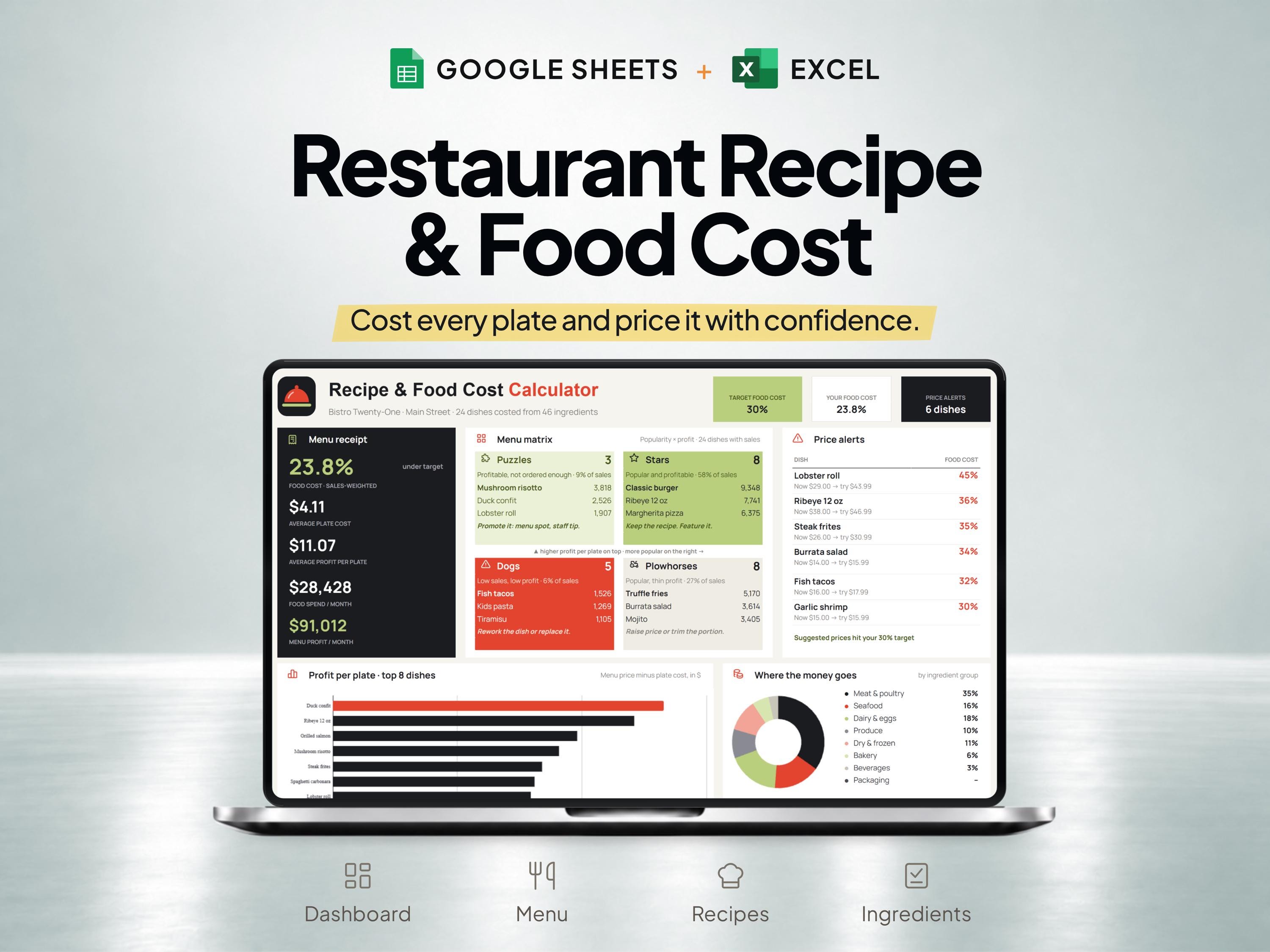
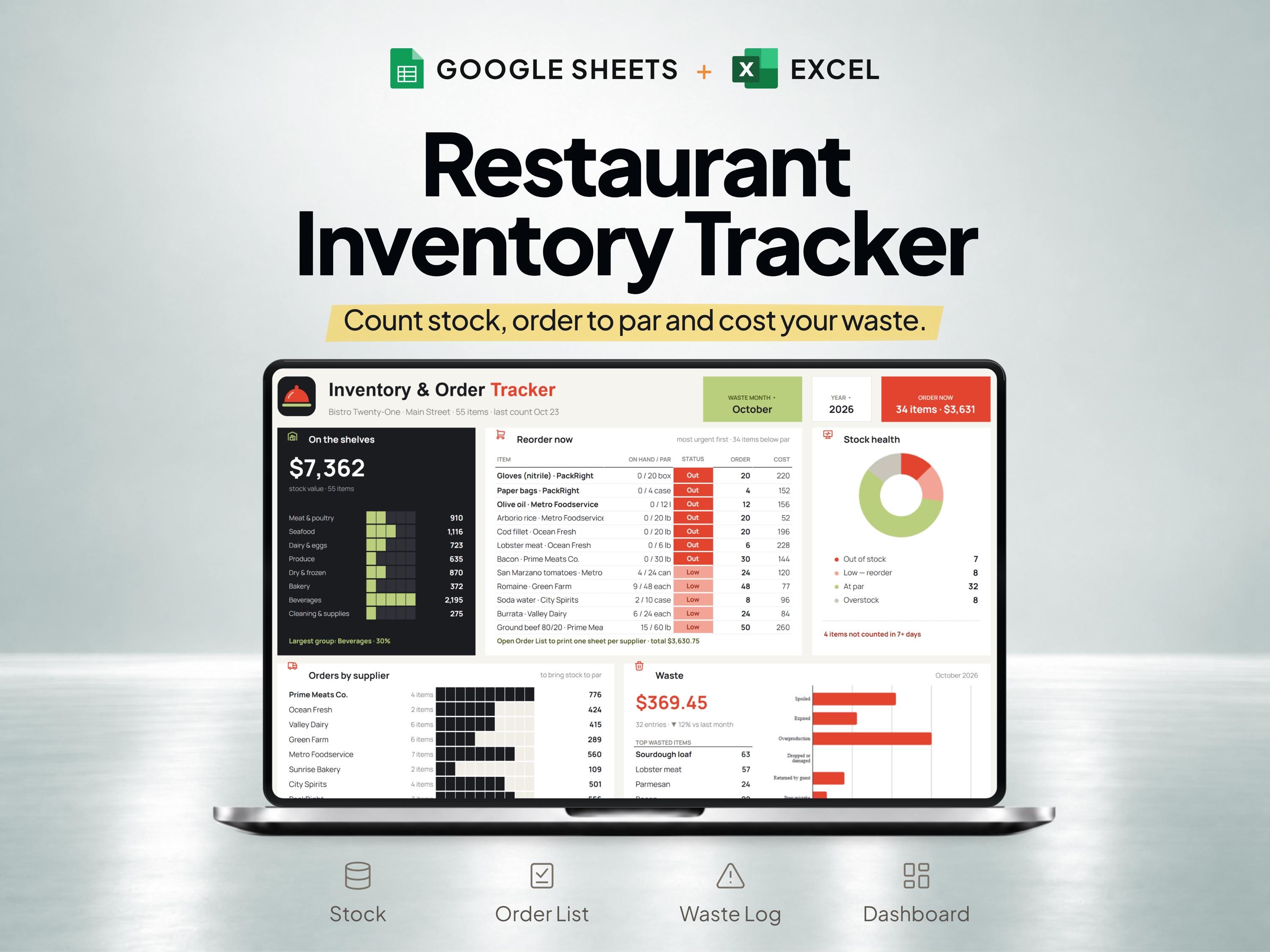
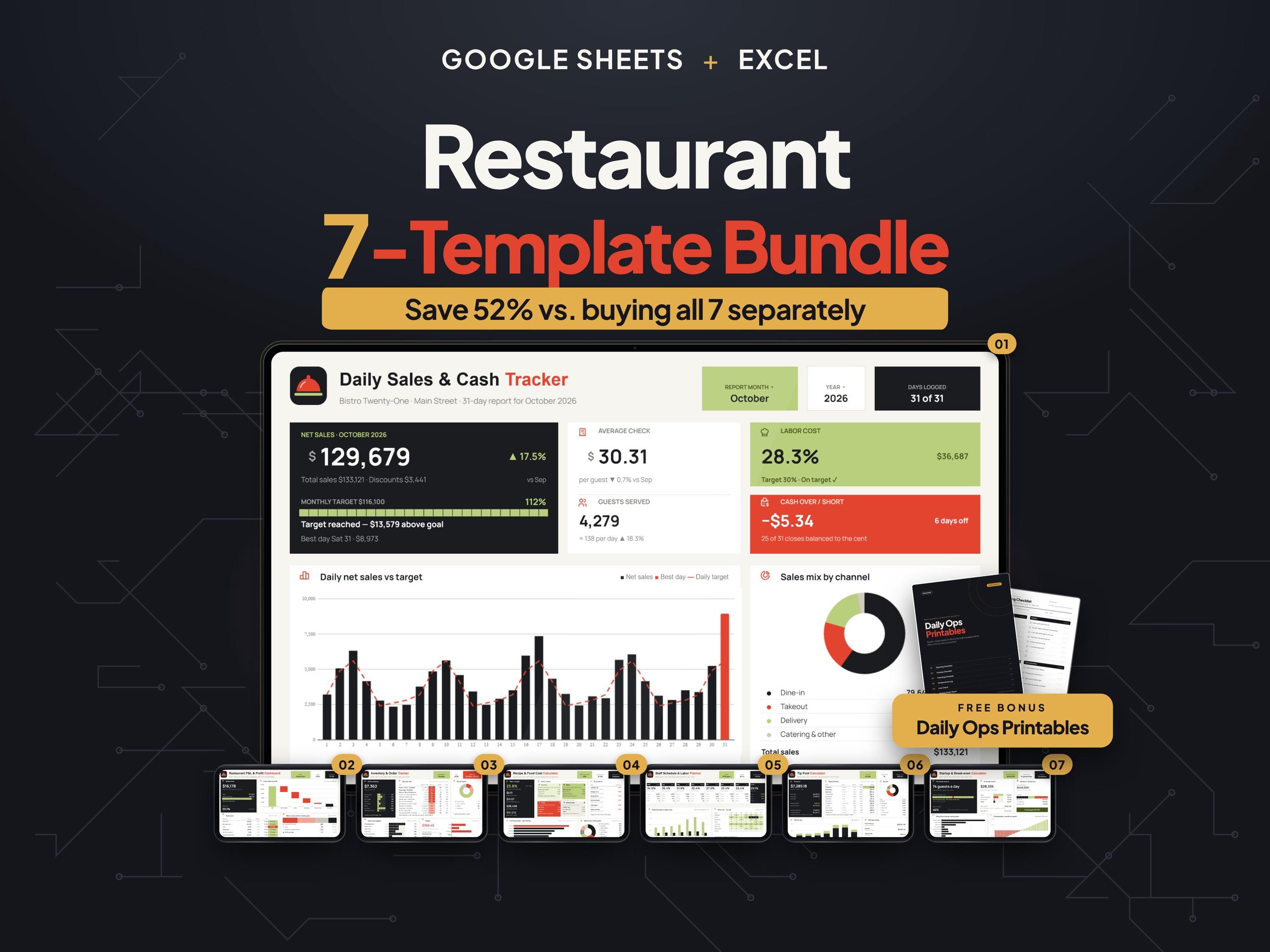
This guide is published by SheetChief, the seller of the linked digital products. The Recipe Cost Calculator spreadsheet covers recipe costs, plate costs and menu-pricing inputs in Google Sheets and Excel. The Restaurant Inventory spreadsheet focuses on food inventory, orders, par levels and kitchen waste records. Compare individual listings with the Restaurant Management Bundle if you need several operating templates. Check the current listing previews and included features before buying.
Put this into practice
Restaurant Spreadsheet Templates for Google Sheets & Excel · Try the free calculator
Compare the actual product previews and included files before choosing a paid template.
Questions, answered
What is the formula for recipe cost per serving?
Add the ingredient costs for the quantities used in one batch, then divide by the number of portions produced. Adjust ingredient quantities for usable yield when necessary.
Should I use the whole pack price?
Use only the cost attributable to the recipe quantity. If a $3 pack contains 1,000 g and the recipe uses 600 g, its ingredient cost is $1.80.
Does ingredient cost show my profit?
No. It excludes other business costs unless you explicitly add them. Use clearly labeled totals for ingredients, packaging and any other cost categories.
Related SheetChief tools
These are our own products. The examples above explain the task; check each Etsy listing to confirm which features and formats are included.