Separate what was due from what was received
Identify the unit, rent period, transaction date, charge, payment amount and payment reference. Record the opening balance explicitly. Use a short note to explain corrections or an agreed allocation.
A due date and a payment date are different facts. Likewise, a monthly rent amount is not proof it was received. Separate charge and payment columns make that distinction visible and allow partial payments without overwriting the original charge.
Worked example: two payments during one rent period
Assume a fictional account called Unit A has a $200 opening balance. October rent is $1,200. Two payments arrive during October: $700 and $400. The closing October balance is $200 + $1,200 − $700 − $400 = $300.
| Date | Entry | Charge | Payment | Balance |
|---|---|---|---|---|
| Opening | Balance brought forward | — | — | $200 |
| 1 Oct | October rent | $1,200 | — | $1,400 |
| 5 Oct | Payment reference A01 | — | $700 | $700 |
| 20 Oct | Payment reference A02 | — | $400 | $300 |
| 1 Nov | November rent | $1,200 | — | $1,500 |
| 3 Nov | Payment reference A03 | — | $1,300 | $200 |
The dash means no charge or payment on that row. In a calculation sheet, enter zero or use a formula that handles the blank consistently. The opening $200 appears once; it is not added again every time a payment is entered.
Choose a transaction ledger or a monthly summary
A transaction ledger gives each charge and payment its own dated row. Its running balance follows previous balance + new charge - new payment. For example, with charge in column C, payment in D and the previous balance in E2, the next balance in E3 is =E2+C3-D3.
A monthly summary instead groups the period's activity: opening balance, rent charged, total payments and closing balance. October's summary is $200, $1,200, $1,100 and $300. November starts with that $300, adds $1,200 and records $1,300, leaving $200.
These layouts and cell references illustrate the method. They are not a promise that a specific product uses the same columns or automatically reconciles transactions.
Handle partial payments without losing the trail
Enter each actual payment with its date, amount and a reference that connects it to your supporting record. Do not replace the first payment with the second one, and do not mark the entire rent charge as paid simply because some money arrived.
When a payment relates to more than one period, document how it is allocated rather than guessing from the amount. Keep the running account balance distinct from any period-specific status. This example demonstrates recordkeeping arithmetic only; it does not determine payment-allocation rules, fees, notices or any legal action.
Reconcile the ledger before relying on the total
Compare recorded payments with the relevant receipts or bank transaction records. Check the amount, reference and date, then mark the entry as reviewed in a way you can recognize later. Investigate unmatched items: they may reflect a missing entry, a duplicate, a timing difference or an amount entered against the wrong unit.
If you discover an error, keep a clear correction note or an adjustment trail so the change is understandable. If money was returned or a payment failed, record what actually happened using a consistent method. Avoid silently deleting the original history. Keep a backup before changing a completed period.
Keep unrelated records distinct
Maintain a clear distinction between rent, deposits, maintenance spending and other categories in your own records. Combining them into one unlabeled payment total makes it harder to understand what the balance represents. A maintenance work order should identify the issue and action taken without changing the rent ledger by accident.
Use fictional examples when sharing a template publicly. In your working file, include only the personal information needed for your recordkeeping, restrict access to appropriate people and review sharing settings before sending a link. This guide focuses on organizing records and does not establish legal, accounting or tax treatment.
Compare the relevant SheetChief tools
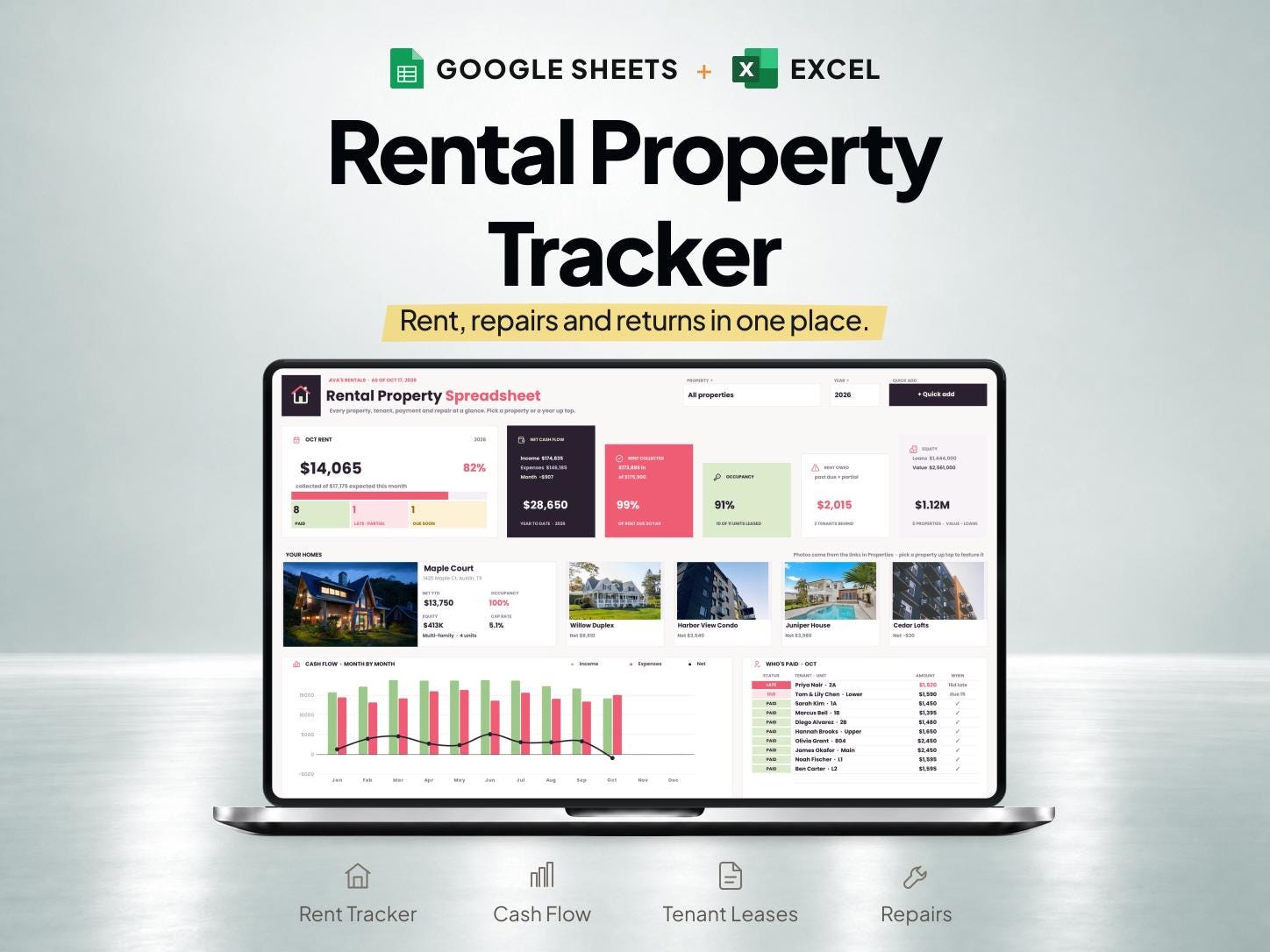
This guide is published by SheetChief, the seller of the linked digital products. The Rental Property and Tenant Rent Ledger spreadsheet is offered for Google Sheets and Excel. Review its current previews and included features to see whether its layout fits the records you want to maintain.
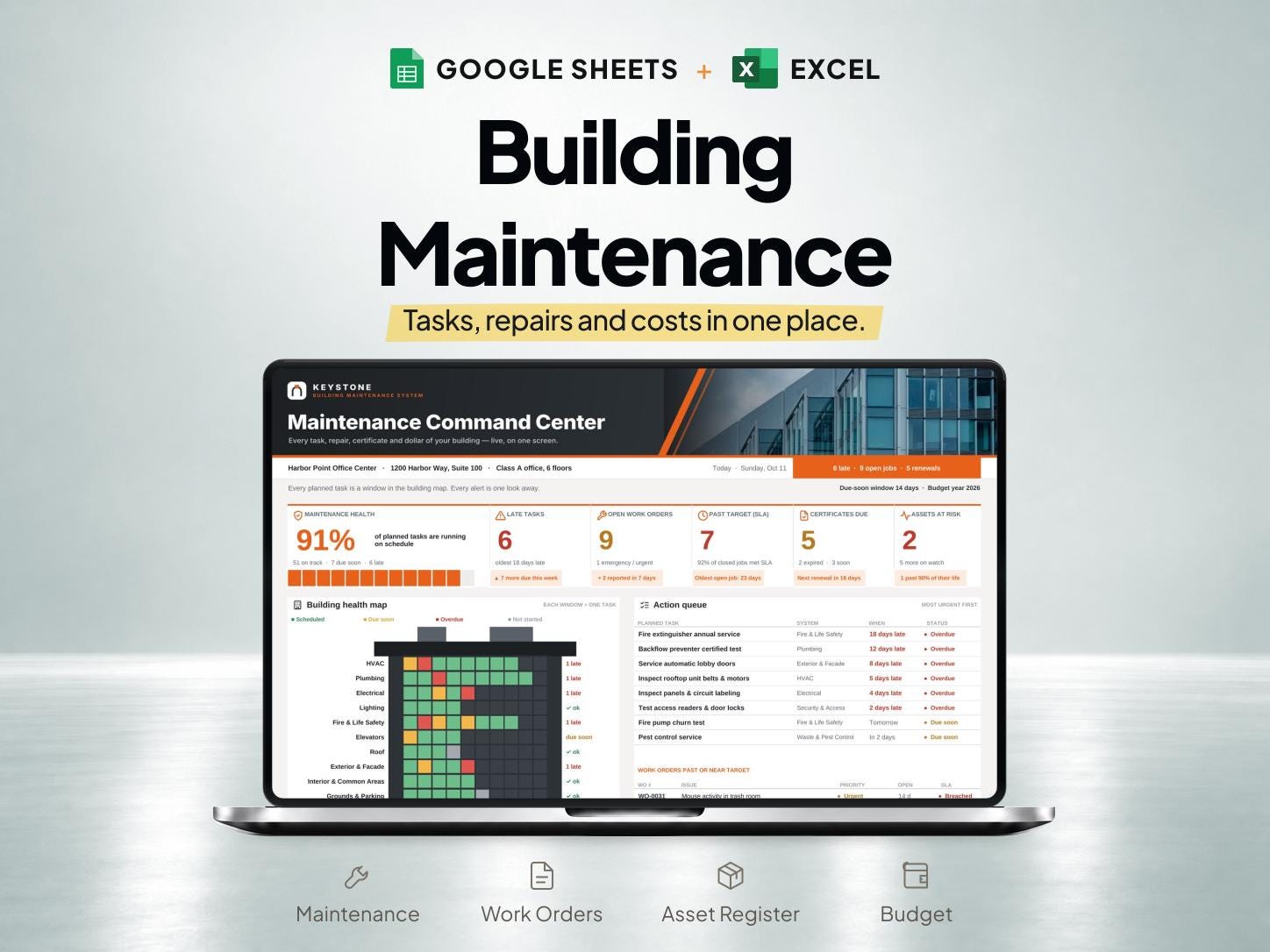
For property upkeep, the separate Building Maintenance Tracker provides a place for maintenance notes, work orders and HVAC maintenance logs. Keeping the purchase decision tied to the actual listing helps you choose a recordkeeping tool without assuming it includes unrelated payment processing or property-management services.
Put this into practice
Rent Ledger, Rental Property & Hospitality Tracking Templates · Try the free calculator
Compare the actual product previews and included files before choosing a paid template.
Questions, answered
How do I calculate the remaining rent balance?
For the simple ledger shown here, add the rent charged to the opening balance and subtract recorded payments. Include any other justified adjustments separately and clearly label them.
How should I enter a partial payment?
Keep the original rent charge, then add a separate payment entry with its amount, date and reference. The running balance decreases only by the amount recorded.
Can I use a monthly summary instead of a transaction log?
A summary can show the period's totals, but retain the underlying payment entries or supporting records so that each total can be checked.
Related SheetChief tools
These are our own products. The examples above explain the task; check each Etsy listing to confirm which features and formats are included.